
China’s Supply Chain
Is Becoming Headquarters
The most important change in Chinese manufacturing is not that some factories are leaving China. Factories have always moved. The more important change is that Chinese firms are learning to keep the brain of the supply chain while moving more of the body around the world.
Richard Baldwin’s globalization framework helps explain why tariffs are a weaker tool than they appear, why know-how matters more than containers, and why China’s next industrial step may be a move from factory economy to headquarters economy.
The phrase “headquarters economy” can sound too triumphant. A better formulation is supply-chain headquarters system. It does not mean every high-value function stays in China or every Chinese company becomes dominant. It means the center of coordination can stay Chinese even as factories, workers, markets, and final assembly spread across Southeast Asia, Mexico, the Middle East, Europe, and elsewhere.
The short answer
Section titled “The short answer”China’s supply chain is becoming harder to contain because the valuable part is no longer only the physical factory. It is the accumulated know-how: engineering habits, supplier coordination, process improvement, equipment knowledge, software, production debugging, and the ability to replicate industrial systems abroad.
Tariffs can make a Chinese-made product more expensive at the border. They cannot easily stop a Chinese company from sending engineers, designs, factory software, supplier playbooks, process knowledge, and capital into another country. They also cannot guarantee that reshored factories will bring back the old jobs, because AI and robotics change the labor equation.
The result is not the end of globalization. It is a more fragmented globalization in which Chinese firms try to become chain leaders rather than only contract manufacturers.
That distinction matters for policy readers. If the question is only “Where is the factory?” then every overseas plant looks like a loss for China or a victory for the host country. If the question is “Who controls the system?” the answer becomes more complicated. A Chinese firm can localize production abroad while keeping product definition, supplier standards, process knowledge, equipment choices, software, and capital allocation tied to the Chinese industrial base.

Globalization changes when goods, ideas, and people face different costs.
Baldwin’s three costs, in plain English
Section titled “Baldwin’s three costs, in plain English”Richard Baldwin’s globalization framework is useful because it separates three kinds of distance.
| Cost | What it means | What changed |
|---|---|---|
| Moving goods | Shipping products across geography | Steamships, containers, ports, logistics, trade liberalization |
| Moving ideas | Coordinating knowledge across distance | Internet, telecom, software, video, cloud collaboration |
| Moving people | Face-to-face trust, tacit knowledge, complex management | Still costly, though travel and remote tools reduce part of it |
The old globalization story was mainly about moving goods. Rich countries could produce at home and sell abroad as transport costs fell. The later globalization story was about moving ideas. Once communication became cheap, firms could split production across borders while still sending designs, specifications, and management knowledge to lower-cost locations.
This is what allowed global value chains to explode after the information and communication technology revolution. It also explains why China’s rise was not simply a story of cheap labor. Cheap labor mattered, but the decisive mechanism was the transfer and absorption of industrial know-how through global production networks.
The next stage is about recombining the three costs rather than removing them. Goods still face tariffs, sanctions, shipping risk, and local-content rules. Ideas move faster than before, but they still require trusted organizations to interpret them. People still matter because tacit knowledge travels through engineers, plant managers, supplier visits, troubleshooting routines, and repeated collaboration.
This is why a headquarters system is not a spreadsheet. It is an operating network. The headquarters has to know which process can be standardized, which component needs local sourcing, which supplier can be trained, which quality issue requires an engineer on site, and which part of the production line should remain near the original cluster. Those judgments are learned through industrial experience, not only through strategy decks.
The old bargain: G7 knowledge plus Asian execution
Section titled “The old bargain: G7 knowledge plus Asian execution”For much of the late twentieth century, the richest economies held a privileged position. They concentrated design, management, brands, capital, and advanced know-how. Lower-cost economies provided labor and manufacturing capacity. Multinationals could keep the “brain” at home and place the “hands” abroad.
China benefited enormously from this arrangement. But it did not remain a passive recipient. Industrial knowledge is sticky when it first arrives, but it becomes learnable through repetition. Engineers improve processes. Suppliers solve edge cases. Workers and managers accumulate judgment. Local firms copy, adapt, and eventually innovate.
Over decades, China built not only factories but industrial memory.
That is why the current contest is different from an old trade dispute. The issue is not simply that China exports too much. It is that China has absorbed and recombined enough know-how to compete in higher-value parts of the system: electric vehicles, batteries, solar, drones, automation, logistics, cross-border e-commerce, industrial software, and increasingly AI-linked manufacturing.
Industrial memory has several layers.
| Layer | Why it matters |
|---|---|
| Supplier memory | Knowing which supplier can solve a problem, scale fast, or survive cost pressure |
| Process memory | Knowing how to tune yield, quality, throughput, and rework in real factories |
| Product memory | Knowing how user demand, engineering constraints, and cost targets interact |
| Equipment memory | Knowing how machines behave under local materials, workers, humidity, power, and maintenance conditions |
| Crisis memory | Knowing what to do when a part fails, a shipment is late, or a regulation changes |
These forms of memory are hard to tariff because they are embodied in people, firms, relationships, routines, and software. They are also hard to recreate quickly. A country can subsidize a plant, but it cannot instantly create decades of supplier argument, factory debugging, operator training, and cost-down pressure.
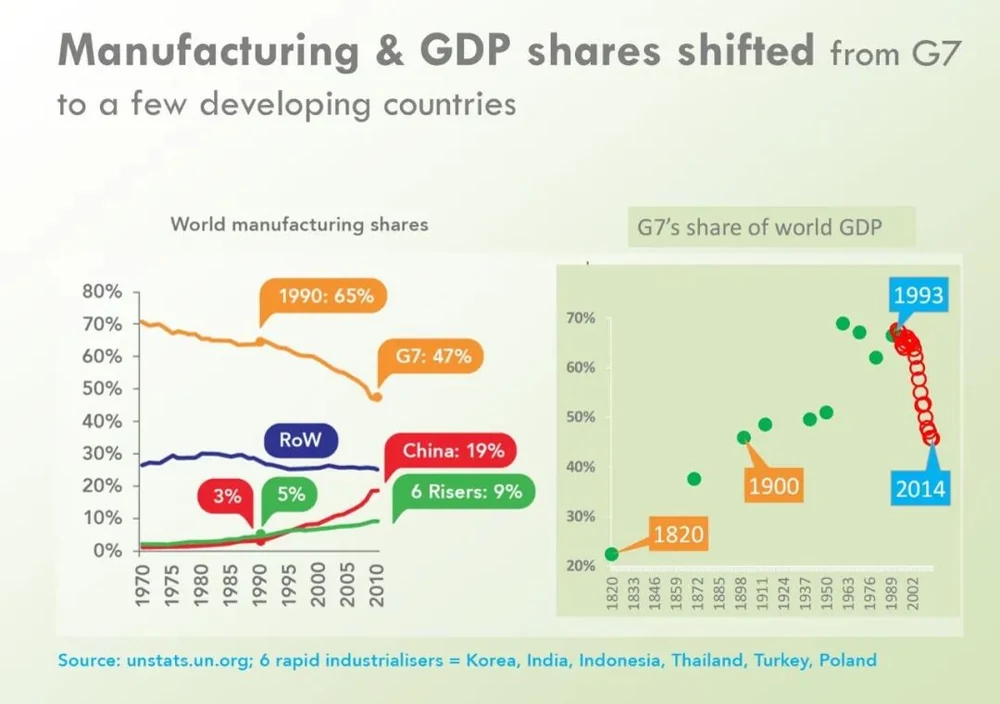
China’s rise was not only about labor cost; it was also about absorbing and recombining industrial know-how.
Why tariffs miss the knowledge layer
Section titled “Why tariffs miss the knowledge layer”Tariffs are visible and politically satisfying because they act at the border. A container arrives, the state charges more, and the policy looks concrete. But supply chains do not consist only of containers.
A modern product contains designs, process knowledge, tooling, supplier relationships, software, quality-control routines, testing methods, and production culture. Much of that can move through engineers, meetings, files, code, machinery vendors, and operating procedures.
Tariffs can stop boxes more easily than they can stop information. A car, battery, or appliance can be taxed at the border. The production playbook can be replicated somewhere else.
This does not mean tariffs are useless. They can change margins, investment decisions, sourcing locations, and timing. They can force companies to build local plants or re-route trade. But those changes may strengthen the global footprint of Chinese firms rather than bring old industrial structures back to the United States or Europe.
Tariffs can even become a forcing mechanism for localization. A company that might have served a market from China may decide to build a plant in Thailand, Mexico, Hungary, Brazil, or Indonesia. That plant may hire local workers and buy local inputs, but the initial production system often travels with the firm. The host country gains capacity. The Chinese firm gains political access and market proximity. The tariff changes the map, but not necessarily the chain leader.
This is the paradox: policies designed to reduce dependence on Chinese goods can encourage Chinese firms to become more global, more localized, and more institutionally embedded in overseas markets. The dependence becomes less visible at the customs line but more complex inside the production network.
BYD Thailand as a small but useful example
Section titled “BYD Thailand as a small but useful example”BYD’s Thailand plant is a useful example because it is not only an export workaround. BYD said the Rayong plant was completed in 16 months, has annual capacity of 150,000 vehicles, and includes stamping, painting, welding, final assembly, and component production. The company also said the project was expected to generate 10,000 jobs.
Those details matter. A plant like this is not simply “China loses production; Thailand gains production.” It is a Chinese firm extending a manufacturing system abroad. The local economy gains jobs and capacity. BYD gains proximity to Southeast Asian markets. China keeps part of the engineering, supplier, brand, and technology logic that made the system possible.
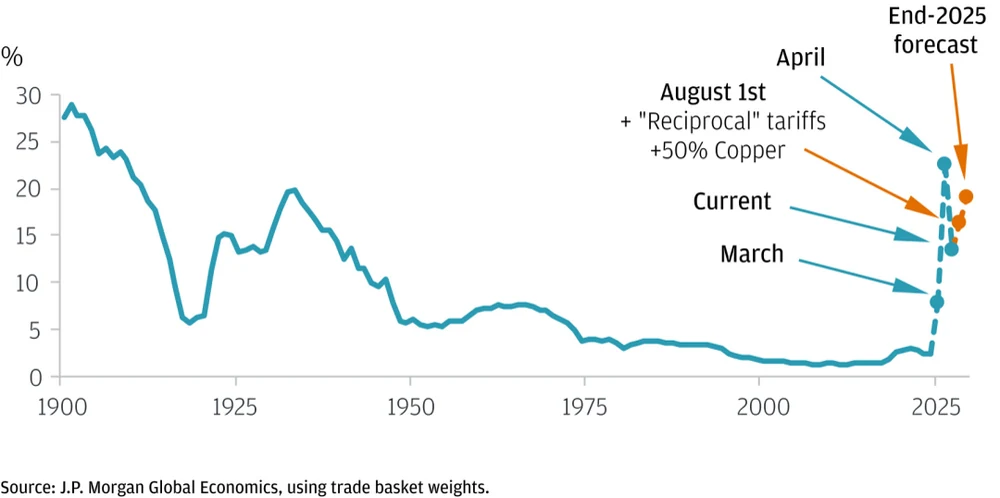
Tariffs can change locations and margins without necessarily changing who controls the production system.
Reshoring may not bring back the old worker
Section titled “Reshoring may not bring back the old worker”Even when production is forced back into high-wage countries, the jobs that return may not be the old jobs. If labor is expensive, firms have a strong incentive to automate.
This is where AI and robotics change the politics of manufacturing. A government can pressure companies to build plants locally. It cannot force those plants to use twentieth-century labor intensity. The rational firm will try to combine local production with robotics, software, and fewer workers.
That is uncomfortable for both sides of the debate. Free-trade optimism underestimated the social pain of deindustrialization. Protectionist nostalgia overestimates how many old jobs can return in recognizable form.
If the work can be automated, reshoring may bring machines, technicians, and engineers rather than mass assembly employment.
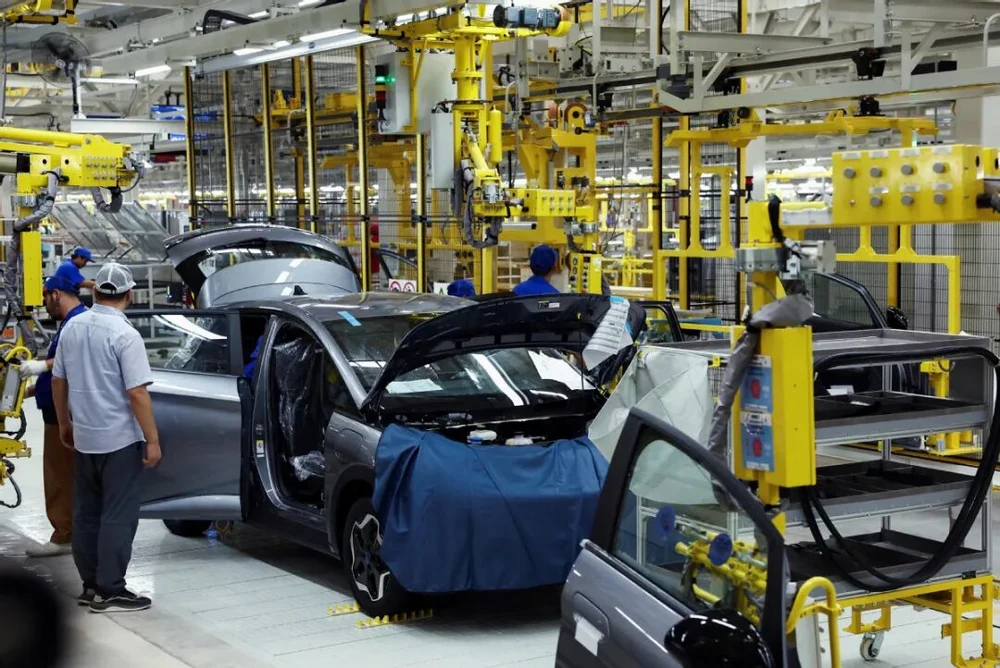
Reshoring can bring machines, technicians, and engineers rather than mass assembly employment.
China’s move from factory to chain leader
Section titled “China’s move from factory to chain leader”The strongest industrial claim is that China is no longer only a factory economy. In sectors such as EVs, batteries, drones, solar, machinery, logistics, and cross-border e-commerce, Chinese firms increasingly generate their own know-how.
That does not mean China controls every strategic layer. It still faces semiconductor equipment constraints, high-end chip limits, geopolitical pushback, brand challenges, and market-access risk. But it does mean the old mental model, where the West designs and China assembles, is increasingly outdated.
The emerging model looks more like this:
| Function | Likely direction |
|---|---|
| Core engineering | Often remains concentrated in China or Chinese-controlled hubs |
| Final assembly | Moves closer to market, tariff zones, labor pools, or political requirements |
| Supplier coordination | Spreads globally but remains linked to Chinese chain leaders |
| Software and process knowledge | Travels with the company, engineers, equipment, and operating system |
| Brand and market adaptation | Becomes more localized as Chinese firms globalize |
This is why the “headquarters” idea matters. The headquarters is not only a legal office. It is the place where product definition, engineering judgment, supplier standards, and process knowledge are coordinated.
What a supply-chain headquarters actually does
Section titled “What a supply-chain headquarters actually does”The headquarters function is easiest to misunderstand because it is partly invisible. It is not just a corporate building, a boardroom, or a registration address. It is the ability to coordinate decisions that determine whether a distributed industrial system works.
| Headquarters function | Practical meaning |
|---|---|
| Product definition | Decide what to build, for which market, at what cost and quality level |
| Supplier architecture | Choose which parts are standardized, localized, dual-sourced, or kept close to core clusters |
| Process replication | Transfer factory routines, quality systems, and equipment settings across sites |
| Engineering escalation | Decide when local teams can solve a problem and when headquarters engineers must intervene |
| Data and software control | Use production data, planning systems, and industrial software to coordinate globally |
| Capital allocation | Decide which country, plant, supplier, or automation project receives investment |
| Brand and compliance | Adapt to local consumers, standards, labor rules, safety rules, and political expectations |
Chinese firms have spent decades learning the manufacturing side of this system at home. The new test is whether they can run it across borders without losing speed, quality, cost discipline, or political legitimacy.
That is much harder than exporting containers. Overseas plants face different workers, managers, unions, ports, energy systems, tax rules, safety norms, and consumer expectations. A headquarters system that ignores local context becomes brittle. A system that localizes too much may lose the advantages of the original Chinese cluster. The winning firms will be those that know what must travel and what must adapt.
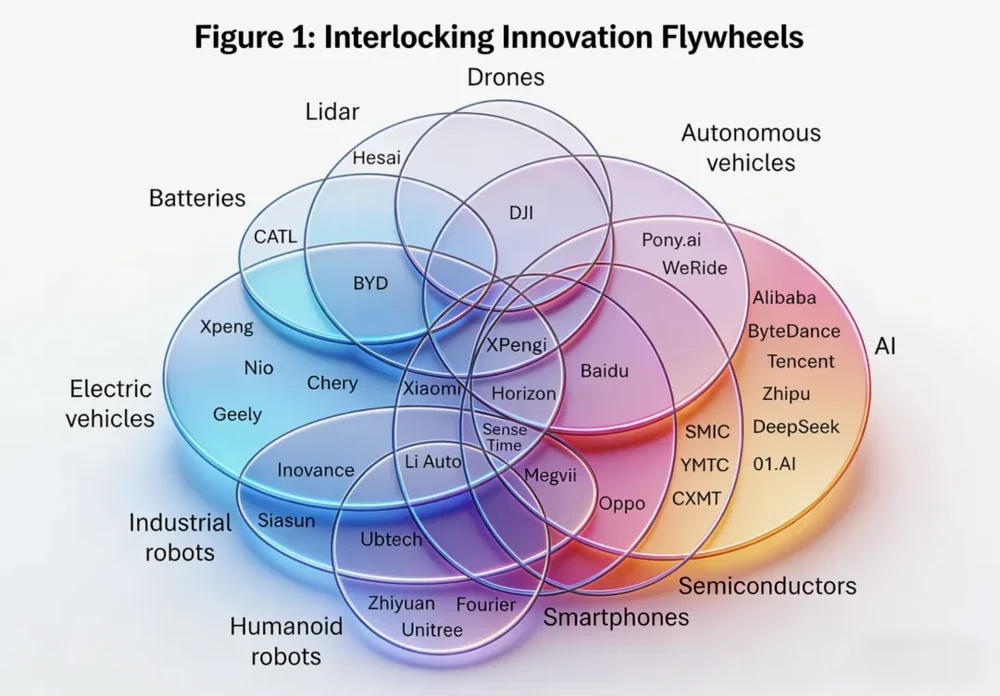
The higher-value question is who coordinates product definition, engineering standards, suppliers, and process knowledge.
The last cost: face-to-face knowledge
Section titled “The last cost: face-to-face knowledge”Baldwin’s third cost, face-to-face interaction, becomes more important when trade and communication costs fall. If goods can move and data can move, the remaining moat is often tacit knowledge: trust, judgment, complex coordination, apprenticeship, negotiation, and problem-solving that is hard to write into a manual.
This is the next challenge for China. A supply-chain headquarters system cannot rely only on cheap production. It needs ecosystems where engineers, suppliers, founders, operators, researchers, and customers collide often enough to generate new knowledge.
That means the domestic industrial base still matters even if factories globalize. China cannot become only a remote manager of overseas labor. It needs dense local clusters that keep producing new process knowledge, new product ideas, new materials expertise, and new automation systems.
This is the part of the story that can be lost in triumphalist readings. If too much production leaves, the learning loop can weaken. Engineers learn by being near problems. Suppliers improve by receiving hard demands from nearby customers. Workers and managers develop tacit judgment through repeated production pressure. A headquarters without a living industrial base eventually becomes a coordinator of yesterday’s knowledge.
So the real strategic question for China is balance. How much production can globalize while the domestic cluster still generates new know-how? Which layers should stay close to R&D? Which mature assembly stages can move? Which suppliers need overseas capacity? Which bottlenecks are too sensitive to spread? These are sector-by-sector questions, not one national slogan.
The social contract problem
Section titled “The social contract problem”The policy point that deserves more attention is simple: protect people, not obsolete capacity.
If China moves upward into chain leadership, some low-end manufacturing will leave or be automated. Trying to freeze every old job in place would be as mistaken as assuming displaced workers can simply absorb the shock alone.
The harder policy task is to build a new social contract around retraining, mobility, unemployment protection, vocational education, and regional adjustment. Industrial upgrading is not painless. A country that wants its firms to fight globally needs a domestic system that helps workers survive the transition.
This is also why the industrial story connects to macro policy. A stronger supply-chain headquarters system can raise national income and strategic resilience, but it can also widen gaps if gains are concentrated in firms, engineers, owners, and regions that already sit near the new industrial core.
For host countries, the social contract question is different but related. A Chinese-led overseas plant can bring jobs, training, suppliers, and exports. It can also create dependence on imported equipment, Chinese management systems, or a narrow assembly role if local upgrading is weak. The best outcome for host countries is not simply attracting a plant. It is learning enough from the plant to build local capability.
That means the next decade of supply-chain competition will not be a clean China-versus-the-world story. It will be a negotiation over who learns, who coordinates, who captures margin, who bears labor risk, and who controls the standards of the industrial system.
What to watch next
Section titled “What to watch next”- whether Chinese firms build more local factories in Southeast Asia, Mexico, Europe, the Middle East, and Latin America;
- whether overseas plants are simple assembly sites or full industrial systems with suppliers and engineering;
- whether tariffs accelerate Chinese firms’ global localization rather than contain them;
- whether automation reduces the employment gains from reshoring;
- whether China’s domestic clusters keep generating know-how as some production moves out;
- whether host countries turn Chinese overseas plants into local capability or remain assembly nodes;
- whether policy shifts from protecting old capacity to protecting workers through transition.
Is China losing manufacturing because factories are moving abroad?
Section titled “Is China losing manufacturing because factories are moving abroad?”Some production is moving, but that does not automatically mean China loses the supply chain. If Chinese firms keep engineering, supplier coordination, process knowledge, and brand control, they may globalize the system rather than abandon it.
Why can’t tariffs solve the problem?
Section titled “Why can’t tariffs solve the problem?”Tariffs affect goods crossing borders. Modern supply chains also move knowledge, designs, software, engineers, and operating routines. Firms can respond to tariffs by moving production locations while keeping control of the system.
What does “headquarters system” mean?
Section titled “What does “headquarters system” mean?”It means the high-value coordination layer: product design, know-how, engineering standards, supplier orchestration, brand, software, and process control. It does not mean every factory remains in China.
Does overseas production weaken China’s industrial base?
Section titled “Does overseas production weaken China’s industrial base?”It can, if too much learning moves away from domestic clusters. But overseas production can also extend Chinese firms’ reach if core engineering, supplier coordination, process knowledge, and new-product learning remain connected to China.
What should host countries watch?
Section titled “What should host countries watch?”Whether local workers, suppliers, engineers, and managers gain real capability from Chinese-led plants. The long-term value is not only jobs, but the transfer of operational knowledge into the local economy.
Does this mean manufacturing jobs are doomed?
Section titled “Does this mean manufacturing jobs are doomed?”No, but it means the old labor-intensive factory job is not the only outcome. Automation and robotics can reduce the number of workers needed even when production returns to high-wage countries.
Sources and further reading
Section titled “Sources and further reading”- BYD official release: BYD Thailand Factory Inauguration and Roll-off of Its 8 Millionth New Energy Vehicle.
- Richard Baldwin, book context: The Great Convergence DOI record.